

The Delegation Matrix (3 Min Read) | Vol. 194
March 13, 2026
“Some decisions are consequential and irreversible — one-way doors — and these decisions must be made methodically, carefully, slowly, with great deliberation and consultation.” – Jeff Bezos
The Delegation Matrix
In my coaching, I see the same pattern over and over. A business owner builds a team, hires good people, and then can’t figure out when to step in and when to step back. The result? They either hover over everything or hand off things they shouldn’t.
Two simple questions can fix this:
- Is this decision impactful or trivial?
- Is this decision reversible or irreversible?
I was recently listening to a fantastic conversation between Brené Brown and Adam Grant. What struck me was how much of the conversation mapped onto a question of when leaders should and shouldn’t engage with their teams.
This led me to a framework I’m calling the Delegation Matrix. It plots every decision on two axes — impact and reversibility — and gives you four clear postures.
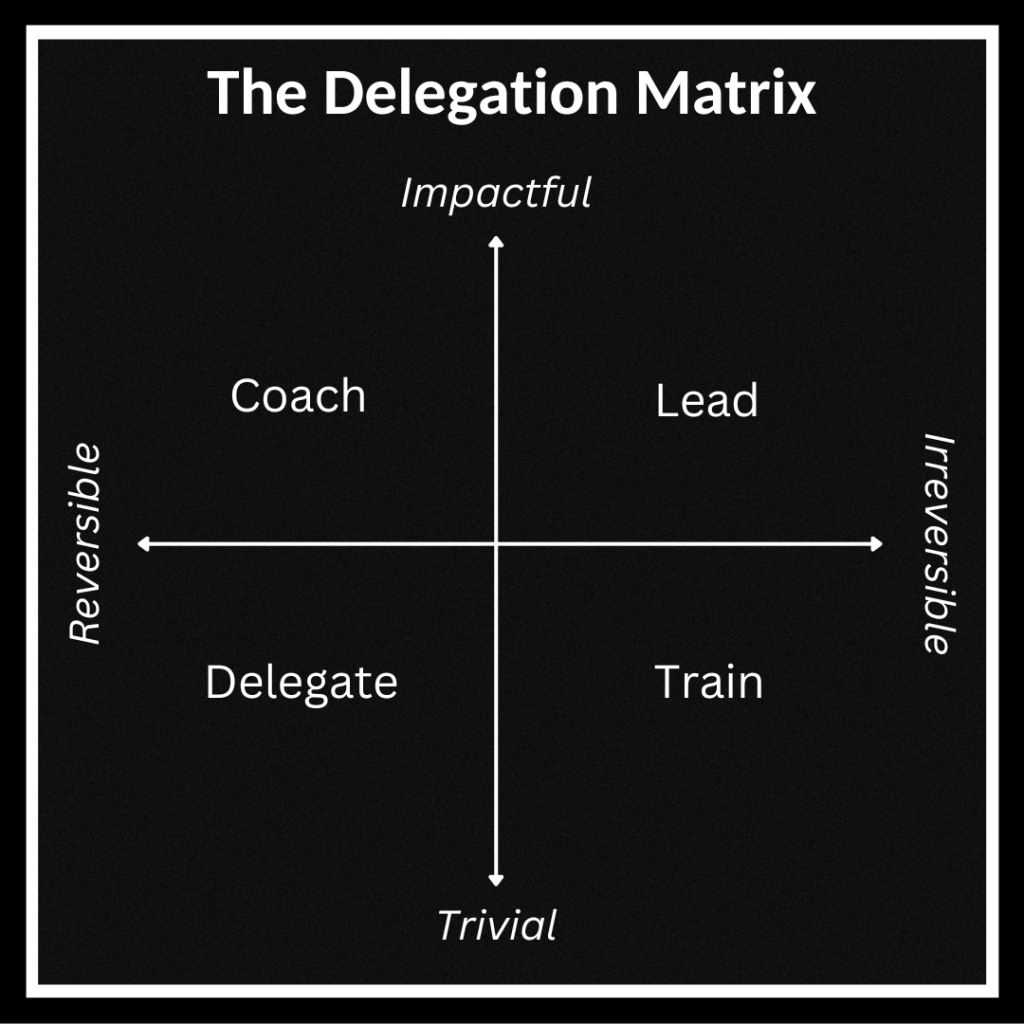
1. Lead — Impactful & Irreversible
These are one-way doors. Hiring a key leader. Signing a long-term lease. Choosing a market. Saying yes to a partnership that reshapes your business. You can’t undo these, and they matter enormously. This is where the leader must be in the room, fully engaged.
2. Coach — Impactful & Reversible
The decision is significant, but the door swings both ways. You can course correct. A new marketing strategy. A pricing change. A restructured team workflow. Here, the temptation is to just do it yourself because it’s important. Resist. This is where coaching pays the highest dividend. Let your people own it with your support.
3. Train — Trivial & Irreversible
These are the sneaky ones. No single instance feels like a big deal, but the consequences stick, and these errors are irreversible. It’s how your team handles client complaints. How contracts get reviewed before signing. How data gets entered into your CRM. Individually, these feel routine. But get them wrong and the damage is done — a client lost, a legal exposure, dirty data you’ll never clean up. You can’t be in the room for these. So you build the system and train to the system. This is how good decisions get made without you at scale.
4. Delegate — Trivial & Reversible
This is the quadrant most leaders paradoxically hoard. Low stakes, easily undone, and yet somehow still on your plate. Scheduling. Formatting. Routine follow-ups. Ordering supplies. If it doesn’t move the needle and it can be redone, it shouldn’t require your attention.
The inability to release trivial, reversible work is the number one reason leaders run out of time for the work that actually matters.
The takeaway? Before your next decision, run it through the Delegation Matrix. Plot the work and let your posture match the quadrant. Lead the things only you can lead. Coach where the stakes are high but the path is flexible. Train where the stakes are hidden but permanent. And delegate everything else.
Knowing the difference is how you show up as a leader instead of a micromanager.
One question to ponder in your thinking time: What am I leading that I should be delegating, and what am I delegating that I should be leading?
Make an Impact!
Jay Papasan
Co-author of The ONE Thing, The Millionaire Real Estate Agent & author of The Rookie Real Estate Agent
Leave a Reply
You must be logged in to post a comment.